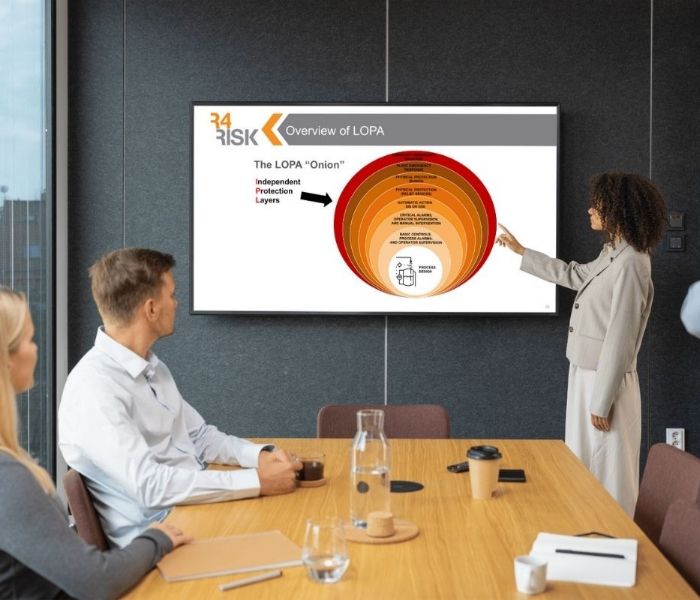
Effective process safety relies on more than simply identifying hazards, it also requires understanding whether the safeguards protecting against those hazards are sufficient to reduce risk to an acceptable level. Once hazards have been identified, organisations need a structured method to determine whether existing safeguards provide sufficient protection or whether additional risk reduction measures are required.
This is where Layer of Protection Analysis (LOPA) plays an important role.
LOPA is a recognised process safety methodology used to evaluate whether independent protection layers are adequate to reduce risk to an acceptable level. However, the quality of a LOPA study depends heavily on the knowledge and experience of the people participating.
Professional LOPA training equips engineers and safety professionals with the practical skills needed to participate effectively in LOPA studies, understand risk reduction strategies, and support safer engineering decisions.
What Is LOPA?
Layer of Protection Analysis (LOPA) is a semi-quantitative risk assessment technique used to evaluate the effectiveness of existing safeguards protecting against hazardous events.
Rather than simply identifying hazards, LOPA asks an important question:
Do the existing protection layers reduce risk to an acceptable level?
If the answer is no, additional safeguards or engineering controls may be required.
LOPA provides a structured framework for evaluating these decisions using recognised engineering principles.
Why Was LOPA Developed?
LOPA was developed to bridge the gap between qualitative hazard identification techniques and more detailed quantitative risk assessments.
While a HAZOP Study identifies potential process deviations and hazards, it does not determine whether the existing safeguards provide sufficient risk reduction.
LOPA provides this additional layer of analysis by evaluating:
- Initiating event frequencies
- Independent Protection Layers (IPLs)
- Risk reduction factors
- Target risk criteria
This enables organisations to make informed decisions about process safety improvements based on recognised methodologies.
What Is an Independent Protection Layer (IPL)?
An Independent Protection Layer (IPL) is a safeguard designed to prevent or mitigate the consequences of a hazardous event.
For a safeguard to qualify as an IPL, it must be:
- Independent of the initiating event
- Effective in performing its intended function
- Reliable and dependable
- Auditable and maintainable
Examples may include:
- Safety Instrumented Systems (SIS)
- Pressure relief devices
- Emergency shutdown systems
- Operator intervention (where appropriate)
- Physical protection systems
Understanding what qualifies as a true IPL is one of the key learning outcomes of professional LOPA training.
How Does LOPA Differ from a HAZOP Study?
Although they are closely related, HAZOP and LOPA serve different purposes.
A HAZOP Study is designed to systematically identify hazards and process deviations.
A LOPA is typically performed after a HAZOP has identified scenarios that require further analysis.
Rather than asking:
“What could go wrong?”
LOPA asks:
“Are the existing safeguards sufficient to reduce the risk?”
The two techniques complement one another and are frequently used together as part of a comprehensive process safety management program.
When Should a LOPA Be Performed?
LOPA is commonly undertaken:
- Following HAZOP studies
- During major process modifications
- When designing new facilities
- Before determining Safety Integrity Levels (SIL)
- When evaluating high-consequence hazards
- During process safety reviews
It is particularly valuable where organisations need greater confidence that existing safeguards are capable of preventing major incidents.
Why Is LOPA Training Important?
LOPA requires more than simply following a worksheet.
Participants need to understand:
- Risk assessment principles
- Frequency estimation
- Independent Protection Layers
- Risk reduction factors
- Human factors
- Engineering judgement
- Industry standards and good practice
Without appropriate training, teams may incorrectly identify IPLs, overestimate safeguard effectiveness, or underestimate process risk.
Well-trained participants contribute to more consistent, defensible and reliable LOPA studies.
Who Should Attend LOPA Training?
LOPA training is valuable for professionals involved in process safety, engineering and operational risk management.
Typical participants include:
- Process engineers
- Chemical engineers
- Safety engineers
- Project engineers
- Operations personnel
- Technical managers
- Process safety specialists
- HAZOP facilitators
It is particularly beneficial for organisations operating within high-hazard industries where robust risk assessment is essential.
How LOPA Supports SIL Assessment
One of the key outcomes of many LOPA studies is determining whether additional risk reduction is required through a Safety Instrumented System (SIS).
The findings from a LOPA often provide important input into SIL Assessment, helping organisations determine the required Safety Integrity Level for specific safety functions.
For this reason, LOPA and SIL Assessment are frequently undertaken as complementary activities within the broader process safety lifecycle.
LOPA as Part of an Integrated Process Safety Strategy
LOPA should not be viewed as a standalone activity.
It works most effectively when integrated with other recognised process safety methodologies, including:
- HAZOP Studies
- Hazard Identification (HAZID)
- SIL Assessment
- Quantitative Risk Assessment (QRA)
- Bowtie Risk Assessment
- Process Safety Management
Together, these techniques provide organisations with a structured framework for identifying hazards, evaluating risks and implementing appropriate safeguards.
Choosing the Right LOPA Training Provider
Effective LOPA training should provide more than an overview of the methodology.
Participants benefit most from training that combines recognised industry guidance with practical engineering examples and real-world case studies.
A quality training program should help participants:
- Understand the LOPA process
- Apply recognised methodologies
- Evaluate Independent Protection Layers
- Support engineering decision-making
- Contribute effectively during multidisciplinary risk workshops
Final Thoughts
As industrial processes become increasingly complex, organisations require structured methods to evaluate whether their safety systems provide adequate protection.
LOPA has become one of the most widely recognised techniques for analysing risk reduction and supporting process safety decisions.
Professional LOPA training equips engineers and safety professionals with the knowledge needed to participate confidently in Layer of Protection Analysis studies, understand Independent Protection Layers, and contribute to safer engineering outcomes.
For organisations committed to improving process safety, investing in LOPA capability helps strengthen both technical decision-making and long-term operational resilience.
About R4Risk
R4Risk provides specialist process safety consulting and professional training for organisations operating in high-hazard industries throughout Australia.
Their expertise includes LOPA Training, HAZOP Studies, HAZOP Leader Training, SIL Assessment, Quantitative Risk Assessment (QRA), Bowtie Risk Assessment, Hazard Identification (HAZID) and broader Process Safety Management services.
By combining practical engineering experience with recognised risk assessment methodologies, R4Risk helps organisations improve safety performance, manage operational risk and make informed engineering decisions.